When my fingers touched the blurred water stain for the first time, it was slowly spreading on a blank page of sketch paper, like a tear and a sprouting seed. I didn’t click any button, but just hung my fingertips on the wet edge and gently guided it — so the ink grew in the direction of my thoughts, winding into a path, leading to a garden suspended in the air drawn with thin pencil lines. _The Collage Atlas_ did not give me a menu or taskbar. It only gave me a breathing dream composed of ink, watercolor, feathers and old pieces of paper. And the way I entered it was not to act, but to become a gust of wind, a pair of eyes, a visitor walking gently in the maze of other people’s hearts.
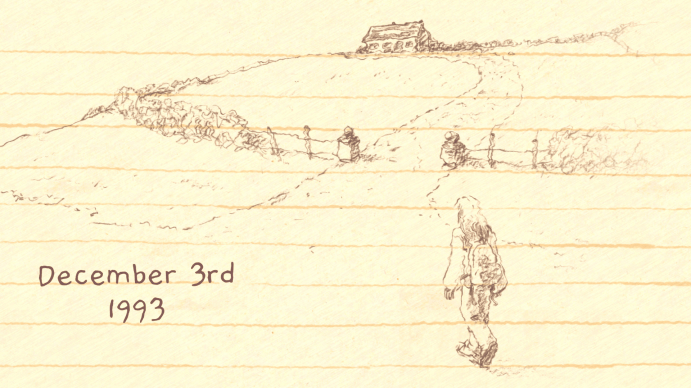
The world is “hand-painted”. This word is not described in art style here, but the essence of existence. The trembling of each leaf and the gradient of every shadow have the subtle texture of the brush rubbing against the paper. The wind has brushstrokes. When it passes through the grass, the grass leaves will fall down and bounce up neatly as if they were drawn by a real pencil line; the rain is dripping with watercolor, and when it faints on the roof tiles, it will leave traces of pigment precipitation. This extreme sense of material makes exploration itself a traceability to the “creative process”. I walked across a bridge, and the texture of the wooden board of the bridge was as clear as if I could touch the wood fiber; I turned over a floating book, and there was a rift edge left by tearing on the edge of the page. Everything implies that the world is not a “finished product”, but a work that is being drawn and continues to evolve because of my gaze.
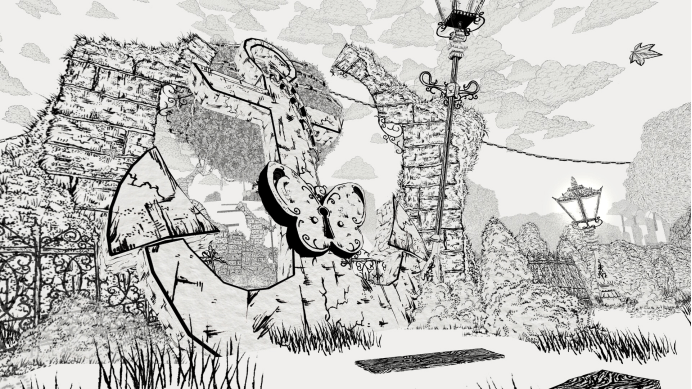
The core interaction of the game is a poetic “guidance” rather than “control”. I can’t jump or run. I can only walk along the path that has appeared or can be summoned. But my attention itself is a tool. Staring at a closed window, fog will gradually emerge on the window glass, and then condense into the shape of a key to memories; stop at a extinguished street lamp for a long time, firefly-like light spots will slowly gather in the lampshade, finally illuminating a hidden alley. Solving puzzles is not logical inference, but emotional resonance. A scene is too dark and heavy? Then I may need to find a faded children’s painting nearby, “activate” it with my eyes, let the bright color blocks in the painting fly out like butterflies, and re-dye the whole scene. The dilemma here is often the dilemma of emotions — the blocked sadness, the frozen time, and the door of the heart that refuses to be opened.
As it goes deeper, the maze begins to reveal its themes: depression, forgetfulness and the exhaustion of creativity. The scene I walked through gradually changed from a bright garden to an attic full of unfinished manuscripts, a corridor with ink stains like tear marks, and a library where books kept falling into the void like fallen leaves. I guided a small figure composed of ink dots to hide under the shadow of a huge eraser that symbolizes self-criticism; I helped a fire of thought trapped in the blizzard letter paper to find the handwriting path to the recipient again. There is no text explanation, and all narratives flow through visual metaphors. I feel that I am not playing a game, but acting as a translator for a silent psychological picture, turning depression into a path, and guiding the silt into a river.
The climax of the game takes place in a place called “Memory Bay”. Here, the tide is composed of shredded diary pages, and the sound of the waves is the rustling sound of pencil writing. I need to “salvage” those key memory fragments from the seawater — a photo, a button, a melody curve — and place them in the correct “memory constellation” atlas. Every time it is successfully placed, the sea area will restore part of its color and sound. At the same time, the lighthouse on the shore, which symbolizes the inner world and has been in a semi-collapsed state, will turn on a layer of light. To repair the world is to repair the heart. When the last fragment returns to its place, the whole lighthouse shines brightly, and all the discrete and gray scenes are connected by the path of a light, forming a complete mental map. At that moment, I suddenly understood that this “atlas” was never an external maze. It was a guide map drawn by the soul’s layers of trauma and beauty for myself to follow.
After quitting the game, I looked at my neat desktop in reality and felt a little strange. _The Collage Atlas_ left me a new perception permission. It makes me believe that the most profound exploration does not necessarily point to the grand puzzles of the outside world, but can point to the detailed mapping of one’s own emotional landscape. It is a psychological picture book opened for you with interaction, telling you that those blurs you think are aimless, those illogical fragments, those graffiti in the dark, when you are willing to look at them with gaze rather than judgment, they will be connected into a glowing clue that takes you out of the fog. Because sometimes, what illuminates the maze is not the lighthouse in the distance, but the first piece of warm confetti with tears that you are finally willing to pick up.