When I was killed by the same monster in the same way for the third time in the alien ruins of _Returnal_, I suddenly burst into laughter at the rebirth point. Not because of madness, but because I finally understood the game: it is not about alien exploration at all, but a psychological treatment wrapped in a science fiction coat.
The game opens with a plane crash. The astronaut I played, Selene, made an emergency landing on the rapidly changing planet Atropos and found that he would return to the crash site after every death. But what really makes me creepy is the fragments of memory that gradually emerge with reincarnation: the piano music played by my mother in childhood, the sound of the brakes at the scene of the car accident, and the ticking sound of hospital instruments — these seemingly random sound effects are piecing together a truth about trauma.
The most shocking discovery comes from the sixth reincarnation. When I broke through the barrier of scarlet wasteland and saw another image of Selene in the holographic records of ancient civilizations, I realized that this planet was a huge psychological projection. Those monsters that keep resurrecting are my inner fear, the changing terrain is the distortion of memory, and the mechanical beast that always chases me is clearly the embodiment of childhood trauma.
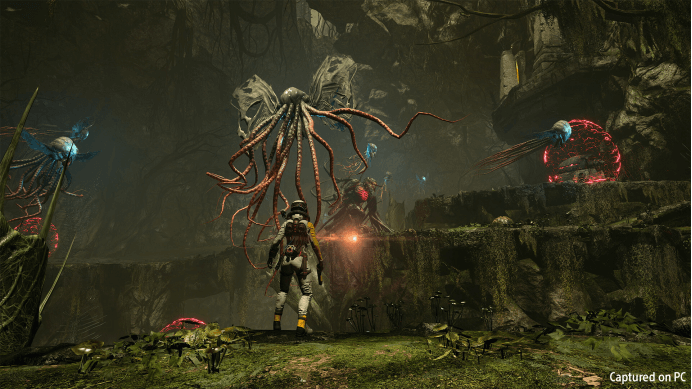
The use of the “cycle” mechanism in the game has reached an artistic height. Each rebirth not only changes the environment, but also unlocks new narrative fragments. In the twelfth reincarnation, I found the reproduction of Selene’s childhood residence. Pushing away the creaking wooden door, the eight-year-old Selene was playing the piano, and the NASA poster was hanging on the wall — this moment made me suddenly choke. It turned out that the sea of stars we chased was just an instinct to escape from trauma.
As the reincarnation deepens, I noticed that Selene’s lines were changing subtly. From the original “must escape” to the later “must understand”, from “this planet is a prison” to “this planet is a mirror”. The most moving twist happened after defeating Hyperion. When the BOSS named the Greek Titan dissipated, what was left was not a weapon, but a memory of reconciliation between Selene and his mother.
At three o’clock in the morning after customs clearance, I stared at the ending animation and burst into tears. When Selene finally drove the spaceship through the atmosphere, what he saw was not the starry sky, but the panoramic view of the ward receiving psychological treatment. It turned out that the whole adventure was self-healing in a coma, and those alien monsters were illusions caused by drug treatment. This subversive truth reminds me of psychologist Jung’s words: “Unless you make the unconscious become consciousness, it will guide your life, and you will call it fate.”
If you have also fallen into some kind of cycle in your life, _Returnal_ will give you the hottest hugs. It will not teach you how to break the cycle, but let you understand that sometimes we need to walk enough times in the cycle to accumulate the courage to walk out. After all, the real healing is not to delete the wound, but to learn to coexist with it.