The first time I scratched the screen with my finger, the diary full of angry words was like a pencil mark erased by an eraser, dissipating from the center into flying star particles. The rustling sound of the stripping of handwriting is like some kind of tiny universe collapsing at my fingertips. I’m not reading the story. I’m dismantle a universe with my own hands — a private universe full of struggle and desire built with a diary in the bedroom of a small Irish town in 1993. What _If Found..._ handed over to me was not a pen, but an eraser. Its narrative is based on a gentle and decisive destruction.
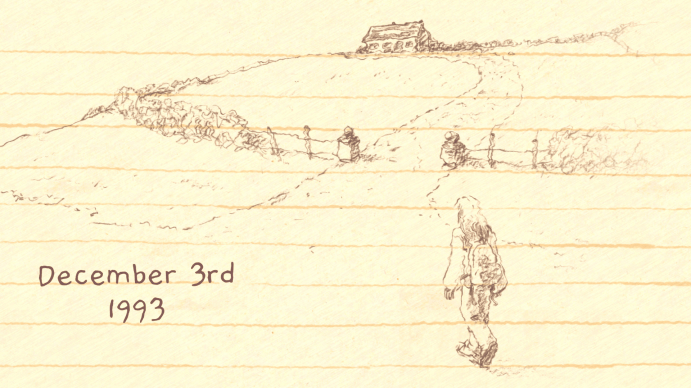
The game begins at home. Kasio returned to his hometown of Achill Island from Dublin, and the rift with his family — especially with his mother — pervaded every scene like sea fog. I advance the narrative by “erasing”: erasing the text on the diary, the images on the photos, and even the pictures of the whole scene with my fingers. This kind of interaction is extremely simple, but full of heavy sense of ritual. Erase a line of confusing poems about gender identity, and those words will turn into stardust and float into darkness; erase a group photo of a family dinner, and the characters on the table will be transparent and disappear one by one, leaving only empty tables and chairs. I’m not erasing traces. I’m witnessing how a memory is deconstructed from the “present” and how it regresses back to the chaotic state of the “past”. Every erasing is accompanied by a trembling mixed with relief and loss, as if you are holding a miniature funeral for yourself in the past.
However, in the gap of destruction, the universe was reborn in another way. Kasio’s thoughts often drifted into deep space. She fantasized that she was an astronaut, driving the spaceship Revelation to explore the edge of the black hole. The oppression and friction in reality — the confusion of the mother, the closure of the town, and the fog of self-awareness — are transformed into a magnificent interstellar picture in the fantasy of the universe: quarrel becomes a gravitational wave disturbance, loneliness becomes a spaceship crossing the endless dark matter, and the pursuit of self-reality becomes a sailing to the singularity without hesitation. When I erase the real scene, the picture often switches to this fantasy universe seamlessly. Here, erasing no longer means disappearing, but means “switching channels”, briefly escaping from the suffocating gravity of reality into a self-dominated and vast metaphorical space. Reality and fantasy, two diaries, two universes, constantly broken, intertwined and intertwined under the wipe of my fingers.
The most moving tension of the game lies in the collision and final reconciliation of these two narrative lines. Kasio writes courage as an astronaut, but bears the fear of “impersonation” on earth; she faces the swallowing of black holes in the universe, but at home, she is overwhelmed by the expectation of love. Until the climax of the story, the boundary between reality and fantasy was completely dissolved. The anger of the mother breaking into the room ruthlessly approached the horizon that turned into a black hole in Kasio’s perspective; and her final and clumsy self-confession to her mother’s power overlapped with the final signal sent by the Apocalypse astronaut to the singularity. Salvation is not from external intervention, but from internal integration: accept that you are both the injured young man trapped in the bedroom of the small town, and the fearless astronaut who dares to sail to the unknown. The last time I executed the erasing and erased the whole scene of the conflict into a gorgeous nebula, I did not erase the contradiction, but sublimated the contradiction into a part of a larger picture.
At the end of the game, Kasio left home and the spaceship. The picture is fixed on a new blank letter. There is no clear ending, only a kind of relief and a piece of silence that can be rewritten. What _If Found..._ leave to me is not the answer, but a methodology. It allowed me to experience how the narrative can be built by “deleting” and how the identity can emerge by “erasing”. It is a love letter to all those who have felt cut off between themselves and reality. It softly tells you that sometimes, the first step to build yourself is to have the courage to erase the words written on your life script by others — including yourself in the past. Then, in the blank space left behind, you will really hear the sound of the stars that belong to you for the first time.