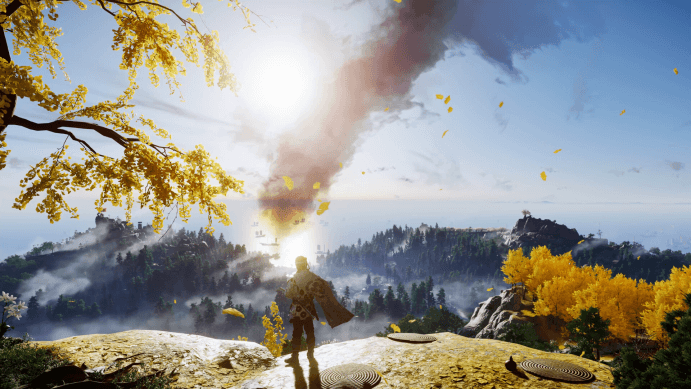
When I first released the handle in _Ghost of Tsushima_ and let the horse carry me through the golden grassland, there was no task prompt in the lower right corner of the screen. Only a breeze brushed the tip of the grass, alarming thousands of fireflies to gather into a star river. At that moment, I suddenly understood that this game is not only about the revenge of the samurai, but also about the practice of finding aesthetics in the fire of war.
The game opens on the bloody beach when the Yuan army landed. The samurai I played, Jin Sakai, witnessed his uncle’s defeat and capture, and Tsushima Island burned under the iron hooves. But when I inadvertently triggered “meditation” for the first time on the way to escape and watched Jin pose for haiku in the bamboo forest, the game suddenly switched to the ink style — the sound of war drums went far away, leaving only the sound of wind, the sound of bamboo leaves and the rustling sound of the tip of the pen sliding on the scroll.
The most shocking experience comes from the application of “inter” aesthetics in the game. On the way to chase the Mongolian generals, I was suddenly blocked by a maple forest. The falling red leaves rotated in the sunset. Jin unconsciously retracted the knife into the sheath and grabbed a maple leaf with his fingertips. This moment, which has nothing to do with the main line, defines the spirit of the warrior more deeply than any battle: the real strong do not charge forever, but know when to stay.
The combat system itself is a fluid aesthetic. When I choose the ghost tactic and sneak in the smoke to assassinate, the scene will transform into a black-and-white silent film in the style of ukiyo-e; and when I proudly propose a duel, the “sincere” scroll will appear in the dry landscape courtyard of the duel field. The most unforgettable thing is to practice with Master Ishikawa under the waterfall. He taught me: “Swordsmanship is not a killing skill, but to let the cherry blossoms learn the rhythm of falling.”
The game’s attention to detail is amazing. When praying in the Cloud Ridge Shrine, Jin’s sleeves will be lifted by the breeze to make real folds; when writing haiku, different choices will attract different small animals — if you choose Crescent Moon, there will be a civet cat squatting next to you, and if you choose Winter Blossom, you will see the white crane stop. Once I sat in the tea room in Izuhara Region all day to see how the light and shadow crawled on the floor. At that moment, I suddenly understood the Mono no Aware in Japanese culture.
As the story progresses, Jin struggles between Bushido and the way of war ghosts. When he finally fought with his uncle in the snow, the moment the two of them faced each other, the snowflakes suddenly stopped all over the sky — this is not a superpower, but the game is saying: the cruelest battle is also worthy of being gazed as art. When my uncle fell down, he didn’t say hatred, but “look how beautiful you have become”. I finally understood that the whole game was the most affectionate confession of the samurai aesthetics.
In the early morning after customs clearance, I walked into the park with my camera. Through the frame, I suddenly saw a different scenery: the light spots refracted by the dewdrops in the spider web are like the morning dew on Tsushima Island, and the falling ginkgo leaves are like the maple forest in the game. The greatest gift of this game is that it reshaped my eyes to observe the world.
If you also want to regain the ability to stare in the impetuous era, _Ghost of Tsushima_ will be your most poetic mentor. It tells us that beauty is never far away, just at the moment when you are willing to stop for a fallen leaf.